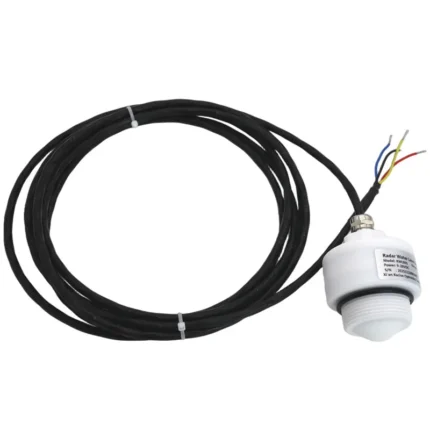
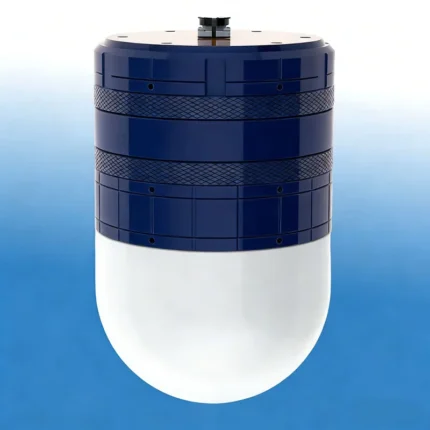
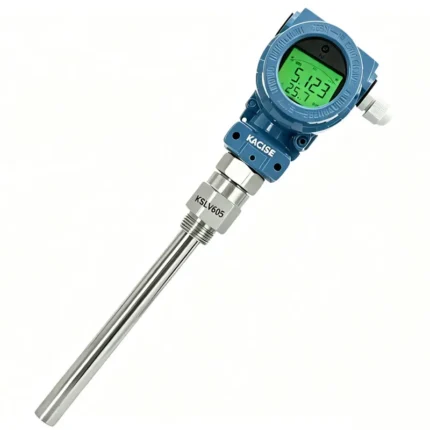
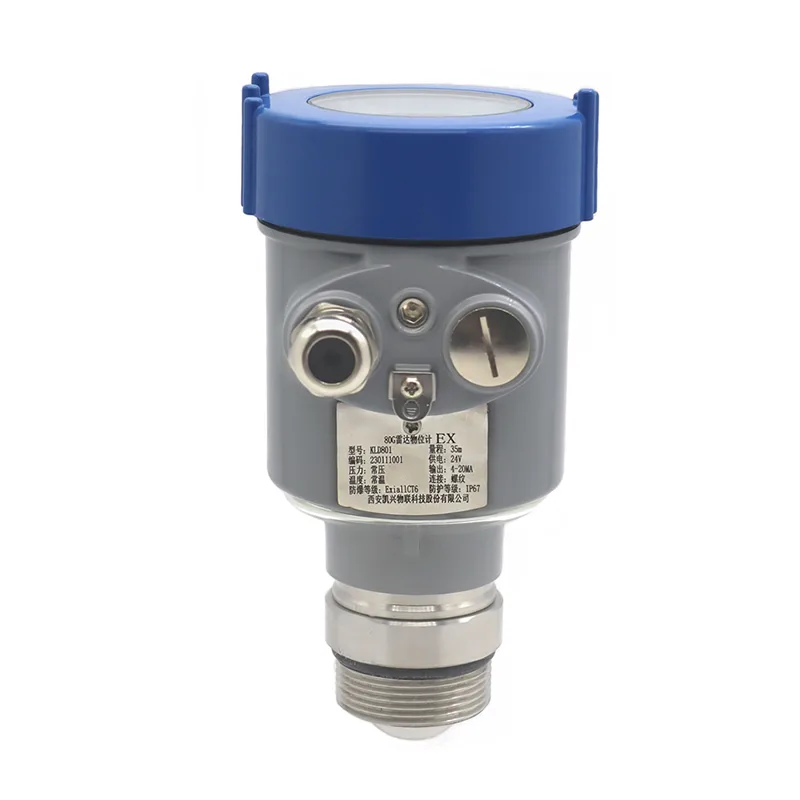
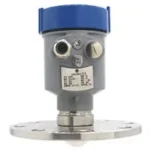
KLD801 Radar Level Sensor Liquids
26GHz Radar Level Sensor
Description
Introduction
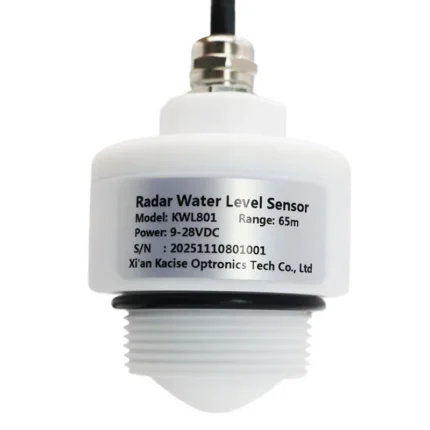
The KLD801 radar level sensor adopts frequency modulated continuous wave (FMCW) technology, and transmits a high frequency continuous frequency modulated radar signal through its antenna. The transmitted signal is reflected by the medium and received by the antenna as echoes with different frequencies. The change in frequency is proportional to the distance and converted to material level height.
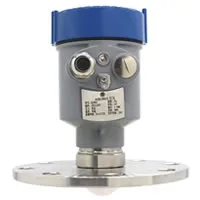
KLD801 Radar Level Sensor 80G ultra-high frequency radar instrument uses a non-contact measurement method to measure the level of liquid and solid media. They measure a wide variety of liquid media, even at high pressures and extreme temperatures. Such as solvent measurement, corrosive medium measurement, hygienic measurement, etc. At the same time, it can also measure light and heavy solids stably and reliably. Even strong dust and noise, adhesion and condensation will not affect the measurement results.
Feature
- Non-contact measurement. The measurement will not be affected by changes in medium properties or process conditions, such as temperature, pressure or dust intensity. Adjusting settings is easy, eliminating the need for filling and emptying containers, saving time during instrument start-up, and making the instrument virtually maintenance-free.
- Large measuring range and small blind area The measurement range is 0.1~120m, which basically meets the measurement requirements of on-site working conditions.
- The antenna size is small, the beam angle is small, and the focusing ability is strong It is convenient for radar on-site installation. It has stronger anti-interference ability for the environment inside the tank. For example, there are stirring, heating coils, baffles, etc. in the tank or the measurement effect in the straight pipe is still good.
- High precision The accuracy can reach ±2mm, which can fully meet the accuracy requirements of non-metering field working conditions.
- The signal wavelength is short It is better for the measurement of the level of powder, particles and so on.
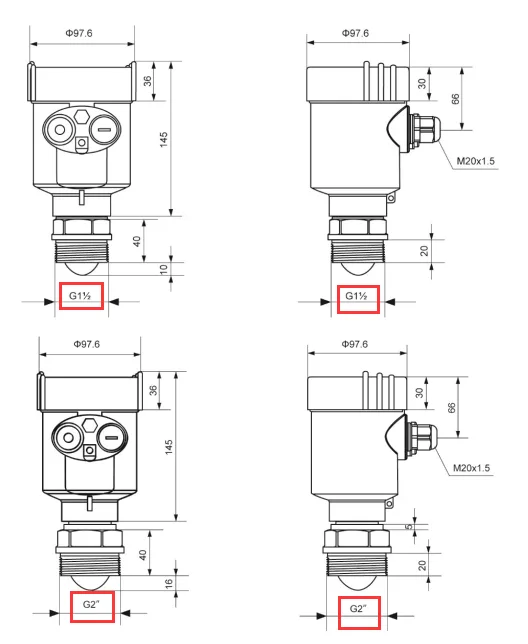
Product Dimension
Unit in mm:
Radar Level Sensor Selection Table
| Medium | Liquid, Non-Corrosive | Non-Corrosive Liquid, Slightly Corrosive Liquid | Strong Corrosive Liquid, Steam, Foam | Non-Corrosive Liquid, Slightly Corrosive Liquid | Strong Corrosive Liquid, Steam, Foam, High Temperature,High Pressure | Solid, Storage Container, Process Container,Strong Dust Application |
| Launch angle | 8° | 8° | 8° | 3° | 3° | 3° |
| Measuring range | 0.05m~100 m | 0.1m~100 m | 0.1m~100 m | 0.1m~100 m | 0.1m~100 m | 0.3m~100 m |
| Connection | G1½A / 1½NPT thread / flange ≥ DN40 | flange ≥ DN80 | flange ≥ DN50 | flange ≥ DN50 | flange ≥ DN80 | flange ≥ DN 100 |
| Temperature | -40~80℃ | -40~110℃ | -40~130℃ | -40~130℃ | -40~200℃ | -40~110℃ |
| Pressure | -0.1~0.3 MPa | -0.1~1.6 MPa | -0.1~2.5 MPa | -0.1~1.0 MPa | -0.1~2.5 MPa | -0.1~0.3 MPa |

Resource
- FAQs about using radar level gauges
- Do you know how to install and measure radar level gauges?
- Ultrasonic, Radar, Capacitive Level Sensors: Which is the best choice for level measurement?
- Radar Level Sensors: An In-Depth Guide